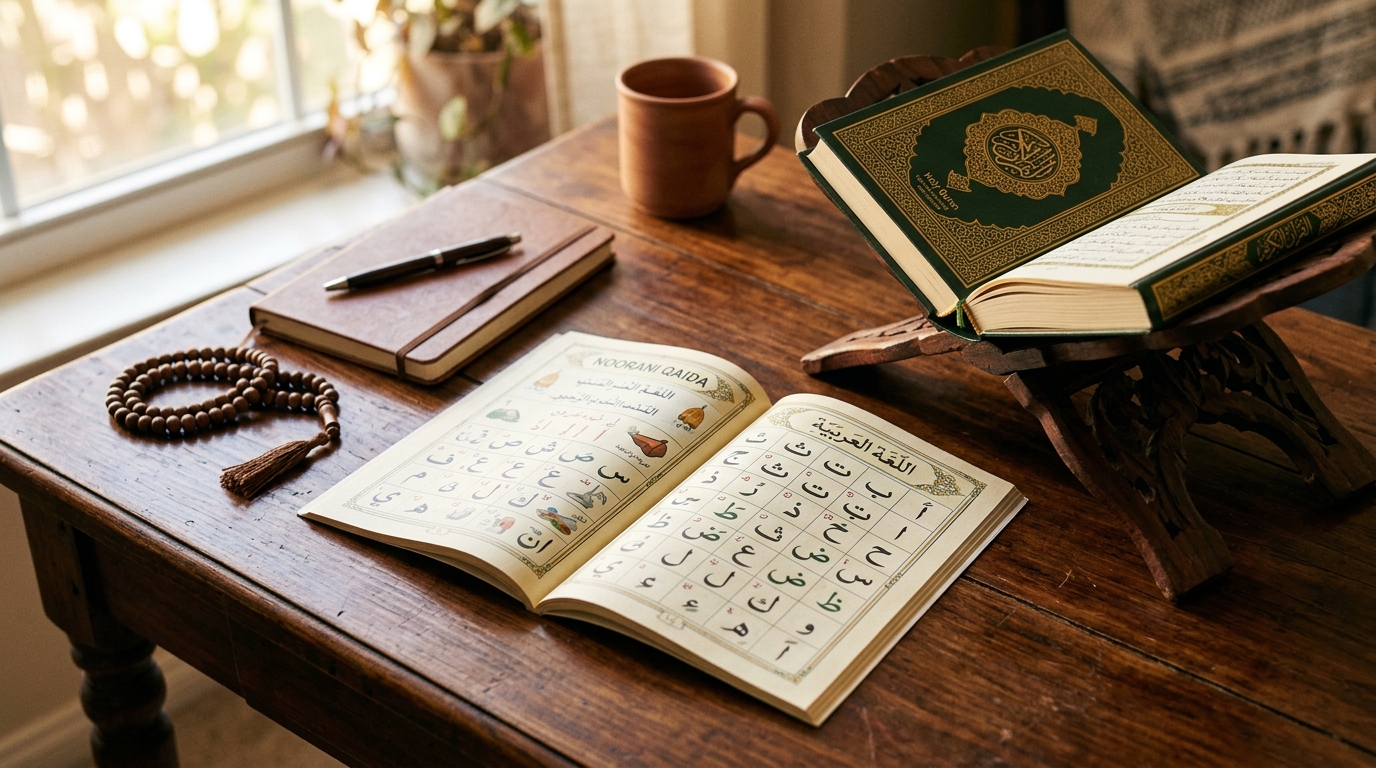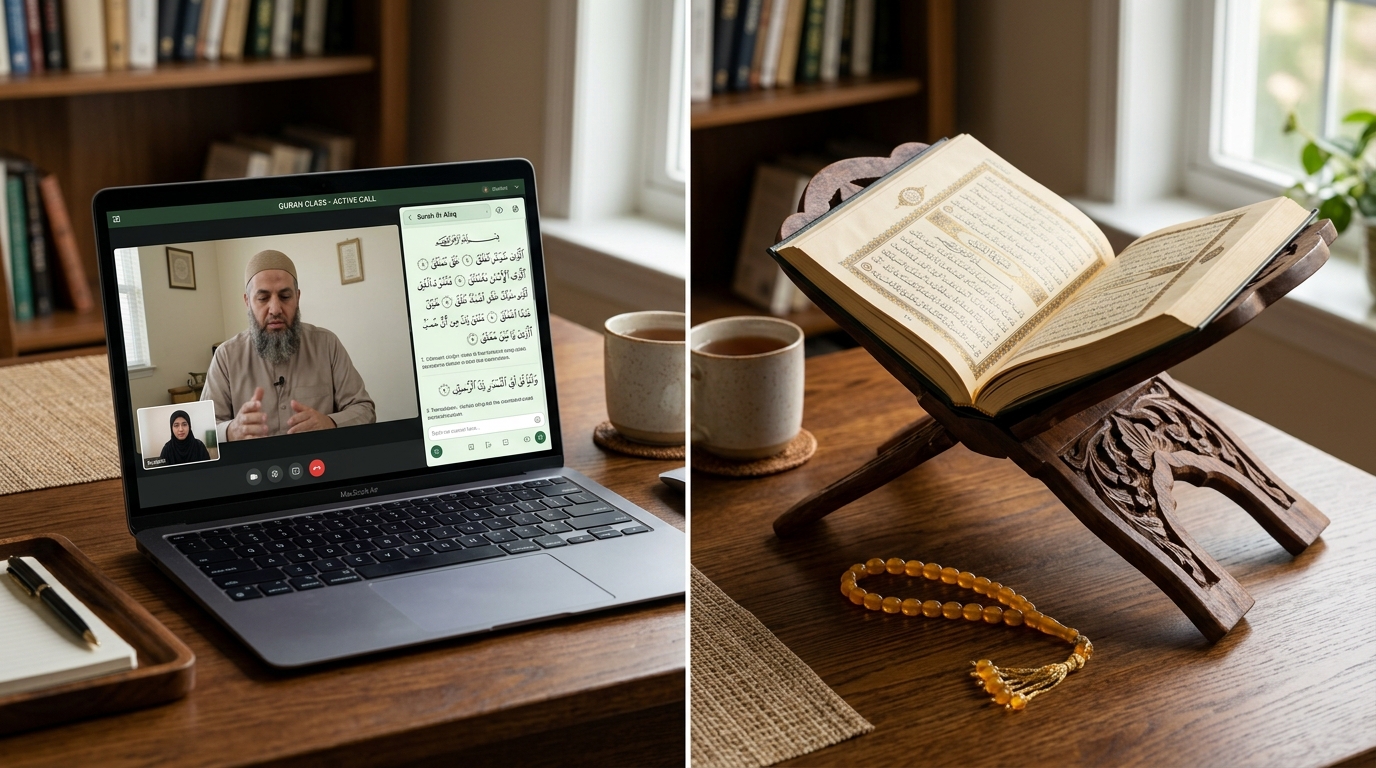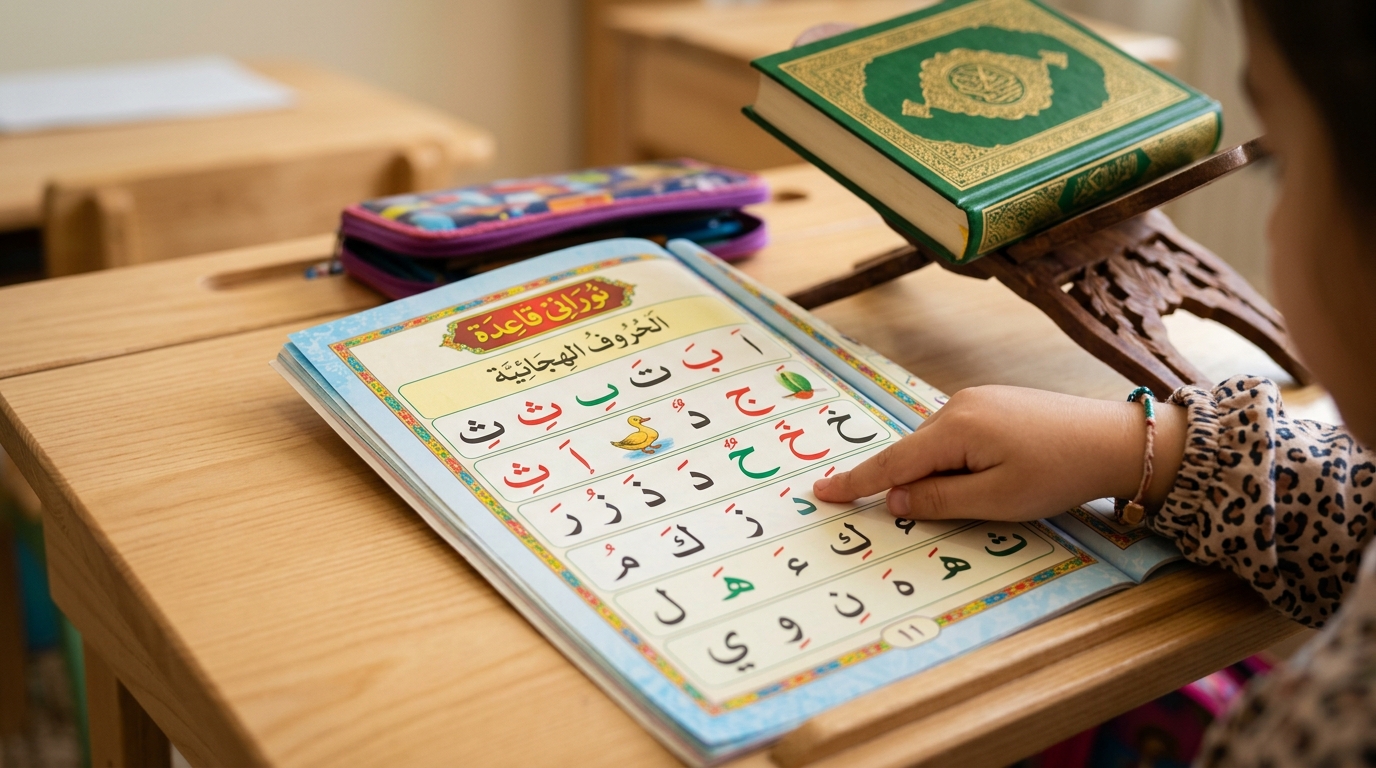
- Learning to read the Holy Quran from scratch follows five distinct structural steps: alphabet recognition, joined letter forms, vowel movements, complex markers, and text application.
- Arabic letters never change their phonetic sound, but they do change visual shapes depending on their position in a word (isolated, initial, medial, final).
- Short vowels (Fatha, Kasra, Damma) must be articulated briskly without stretching to prevent accidental grammatical corruption.
- Graduating from Noorani Qaida to the Mushaf is best achieved by starting with the short, rhythmic chapters of the 30th Juz (Juz Amma).
Opening the Holy Quran for the very first time as a beginner can evoke a mixture of deep spiritual longing and intense intimidation. The flowing, elegant Arabic calligraphy, the intricate diacritical markings above and below letters, and the unfamiliar right-to-left orientation can make fluent reading seem like an impossible mountain to climb.
Yet millions of Muslims across every continent—from native English, Urdu, French, and Somali speakers to adult reverts—have successfully learned to read the Quran fluently from absolute zero.
The secret is not innate linguistic talent; it is adhering to a step-by-step, cumulative pedagogical method. By mastering one building block before introducing the next, reading Allah's divine revelation becomes natural, intuitive, and deeply rewarding.
To learn Quran reading as a beginner, follow this proven 5-step sequence: 1) Master the 28 isolated Arabic letters and their Makharij (pronunciation points); 2) Learn how letters connect in words (initial, medial, final forms); 3) Practice the short vowels (Fatha, Kasra, Damma) and Tanween; 4) Understand Sukoon (resting mark) and Shaddah (doubling mark) in Noorani Qaida; 5) Transition to reading short Surahs from Juz Amma under live teacher supervision.
The 5-Step Beginner Quran Reading Blueprint
The following master curriculum guides you from the very first letter to independent recitation:
| Step | Core Competency | Primary Concepts Learned | Typical Duration |
|---|---|---|---|
| Step 1 | Single Alphabet & Articulation | 28 isolated letters; Makharij of throat & tongue | 2–3 Weeks |
| Step 2 | Connecting Letter Forms | Initial, medial, and final cursive variations | 2–3 Weeks |
| Step 3 | Short & Long Vowels | Harakat (Fatha, Kasra, Damma) & Madd letters | 3–4 Weeks |
| Step 4 | Advanced Diacritics | Tanween, Sukoon, Shaddah, and silent letters | 4–6 Weeks |
| Step 5 | Continuous Text Reading | Juz Amma recitation, stopping rules (Waqf) | 6–8 Weeks |
---
Step 1: Mastering the 28 Isolated Letters (Huroof Mufradat)
Arabic is a strictly phonetic language consisting of 28 consonants. Unlike English, where vowels and consonants frequently break rules (consider "tough," "through," and "dough"), Arabic letters never change their fundamental phonetic values.
During this initial stage, you must focus on: - Visual Distinction: Learning each letter's unique geometric shape and dot configuration. For instance, ب has one dot below (Baa), ت has two dots above (Taa), and ث has three dots above (Thaa). - Points of Articulation (Makharij): Training your vocal apparatus to produce non-English sounds accurately. - Throat letters like ع (Ayn) from the middle throat and ح (Haa) from the vocal cords. - Emphatic letters like ص (Saad), ض (Daad), ط (Taa), and ظ (Dhaa) where the back of the tongue elevates to create a deep, resonant tone.
For an anatomical guide to every sound, see our Makharij al-Huroof Guide.
Step 2: Understanding Joined Letter Forms (Al-Murakkabat)
Arabic is a cursive script, but not every letter joins to the following letter. Learners need practice with both joined and non-joining forms. A letter's visual presentation adapts based on whether it appears at the beginning, middle, or end of a word: - Initial Form: The letter sheds its wide tail and retains only its identifying "head" and dots to connect to the next letter (e.g., بـ). - Medial Form: The letter connects on both sides with connecting arms (e.g., ـبـ). - Final Form: The letter completes the word and returns to its full, sweeping tail (e.g., ـب). - The "Naughty Six" Letters: Six Arabic letters never connect to the letter following them: ا, د, ذ, ر, ز, و (Alif, Daal, Dhaal, Raa, Zay, Waw). Practise these non-joining letters in the text your teacher selects.
Step 3: Mastering Vowel Movements (Al-Harakat)
Arabic words are not constructed by spelling out vowels like in English. Instead, small diacritical symbols called Harakat (movements) sit above or below consonants: 1. Fatha ( َ ): A short slanted stroke above a letter producing a crisp "ah" sound (e.g., دَ = Da). 2. Kasra ( ِ ): A short slanted stroke below a letter producing a crisp "ee" sound (e.g., دِ = Di). 3. Damma ( ُ ): A miniature comma-like mark above a letter producing a crisp "oo" sound (e.g., دُ = Du).
Golden Rule for Beginners: Harakat are short. Pronounce them briskly. If you stretch a Fatha, it accidentally turns into an Alif, which changes a word's meaning from singular to plural or past to present!
Following Harakat, you learn Tanween (double vowels: an, in, un), which adds a hidden 'N' sound to the endings of words.
Explore our Learn Noorani Qaida Online curriculum to practice these vowel transitions.
Step 4: Mastering Advanced Phonetic Marks (Sukoon & Shaddah)
Once you can read vowel-moving words, you unlock the advanced architectural markers of Arabic script: - Sukoon ( ْ ): A small circular or crescent mark indicating that a letter is at rest (has no vowel). A letter with Sukoon cannot be pronounced alone; it must attach to the moving letter preceding it (e.g., أَبْ = Ab). - Shaddah ( ّ ): A small 'w'-shaped mark representing letter doubling (Tashdeed). The letter is held briefly with tension and then released with a vowel (e.g., رَبَّ = Rabba). - Huroof Maddah (Vowels of Elongation): Learning when to stretch a vowel for 2 counts (Alif preceded by Fatha, Waw preceded by Damma, Yaa preceded by Kasra).
Step 5: Transitioning to Juz Amma & Continuous Verses
Once you successfully pass your Noorani Qaida graduation review, you open the Holy Quran to Juz Amma (the 30th Juz). - Start with Surah Al-Fatiha: Perfect every single syllable, as it is the foundation of your daily prayers. - Short Surahs First: Progress backwards from Surah An-Nas, Surah Al-Falaq, and Surah Al-Ikhlas up toward Surah Ad-Duha. These short verses have natural, rhythmic cadences that rapidly build reading momentum. - Rules of Stopping (Waqf): Learn how to pause gracefully at verse ends, transforming short vowels into resting Sukoons.
For deeper mastery of rhythmic beautification, explore our Online Tajweed Course.
4 Proven Habits for Rapid Quran Reading Success
- Daily Consistency Trumps Marathon Sessions: Practicing 15 minutes every single day produces regular opportunities to revisit material than studying for two hours once a week.
- Never Use English Transliteration: Transliteration (e.g., "Qul huwal laahu ahad") is a dangerous trap. It cripples your ability to recognize Arabic script and distorts unique letters like Ayn and Ha. Commit to reading real Arabic from day one.
- Point with Your Finger or Stylus: Tracking each letter with your index finger or a digital stylus focuses your visual gaze and prevents your eyes from skipping small vowel markers.
- Learn Under Live Ijazah-Certified Supervision: Self-study cannot detect subtle tongue slips. A qualified teacher provides immediate auditory correction, saving you months of misdirected effort.
Your Quran Journey Begins Today
The Prophet Muhammad (peace be upon him) gave beautiful encouragement to every beginner: > "The one who is proficient in the recitation of the Quran will be with the honorable and obedient scribes (angels), and he who recites the Quran and finds it difficult, stammering over its verses, then he will have a double reward." (Sahih Muslim 798)
Every struggle you experience while sounding out these holy letters is counted and multiplied by Allah.
Take your first step toward confident Quran reading today. Book your free 1-on-1 trial class at QuranHeaven and let our caring tutors guide your first verses.