πŸ“ž +1 (317) 751 5969 USA | πŸ’¬ WhatsApp | ✨ Free Trial Class
Online Quran Classes ✨ Updated September 4, 2026 ⏱ 7 min read

How to Learn Quran Online: A Complete Guide for Beginners

SA
Reviewed by Sheikh Abdullah Lead Islamic Instructor
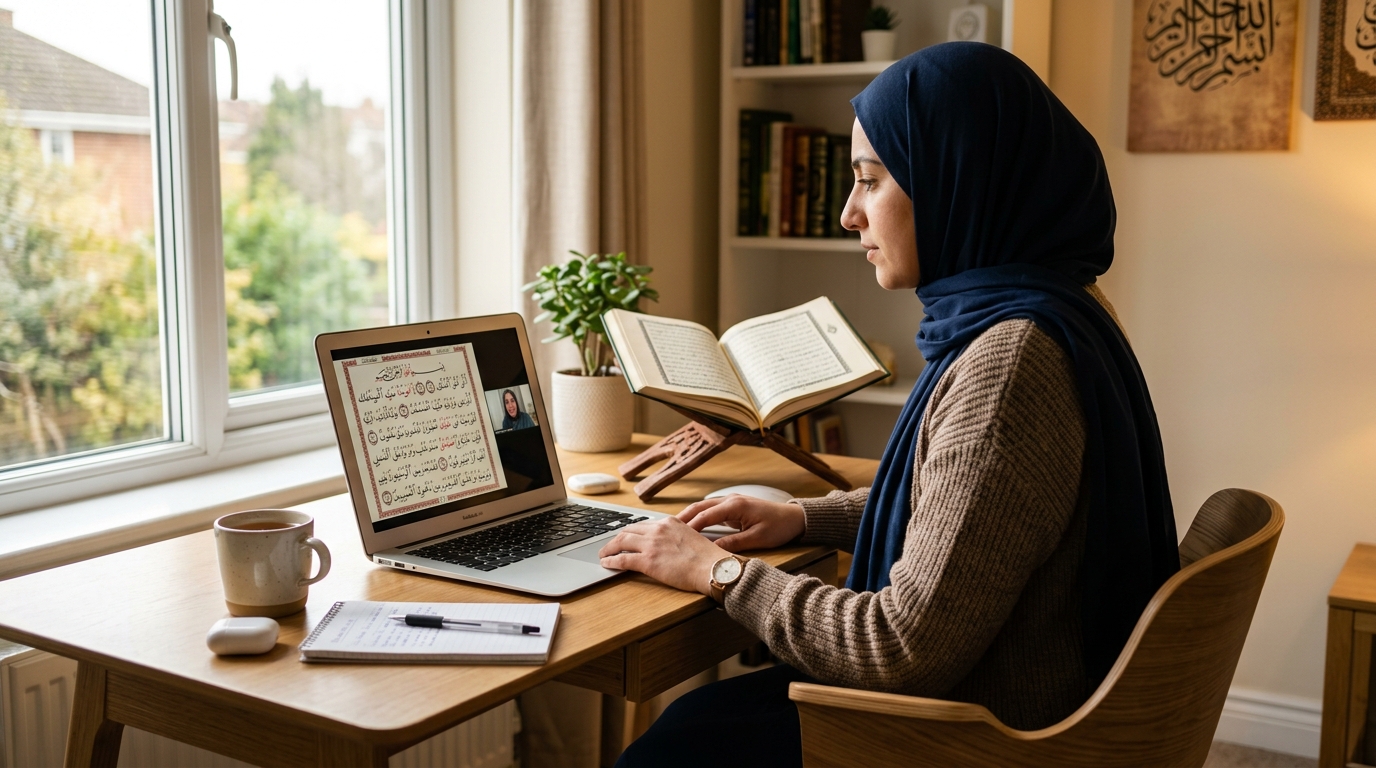
Student learning Quran online on a tablet with an interactive digital Mushaf
πŸ’‘ Key Takeaways (TL;DR)
  • Learning Quran online connects students worldwide with authentic, Ijazah-certified native tutors through flexible, 1-on-1 virtual sessions.
  • The proven beginner progression follows a structured sequence: Arabic letter recognition, Noorani Qaida phonetics, Tajweed rules, and Juz Amma recitation.
  • Dedicated 20 to 30-minute daily practice sessions produce significantly higher retention than irregular weekend cramming.
  • Modern interactive toolsβ€”such as digital color-coded Mushafs and live screen annotationβ€”make remote Quranic learning as effective as classical in-person Talaqqi.

Learning the Holy Quran is a sacred obligation and a deeply rewarding spiritual endeavor for every Muslim. Historically, studying the Quran required daily travel to a local mosque, madrasah, or traditional Kuttab. However, modern educational technology has revolutionized Islamic education. Today, whether you reside in North America, Europe, Australia, or anywhere else, you can learn Quran online under the direct live guidance of qualified, Ijazah-certified scholars without leaving the comfort and safety of your home.

This comprehensive beginner's guide provides an actionable, step-by-step roadmap for starting your online Quran journey from absolute zero.

⚑ Quick Answer

To learn Quran online as a beginner, select an accredited online Islamic academy offering live 1-on-1 classes with Ijazah-certified tutors. Begin with the Noorani Qaida to master Arabic letter recognition and Makharij (points of articulation), progress into basic Tajweed rules, and practice consistently for 20–30 minutes daily through the classical Talaqqi method.

Why Learn Quran Online? The Modern Islamic Learning Revolution

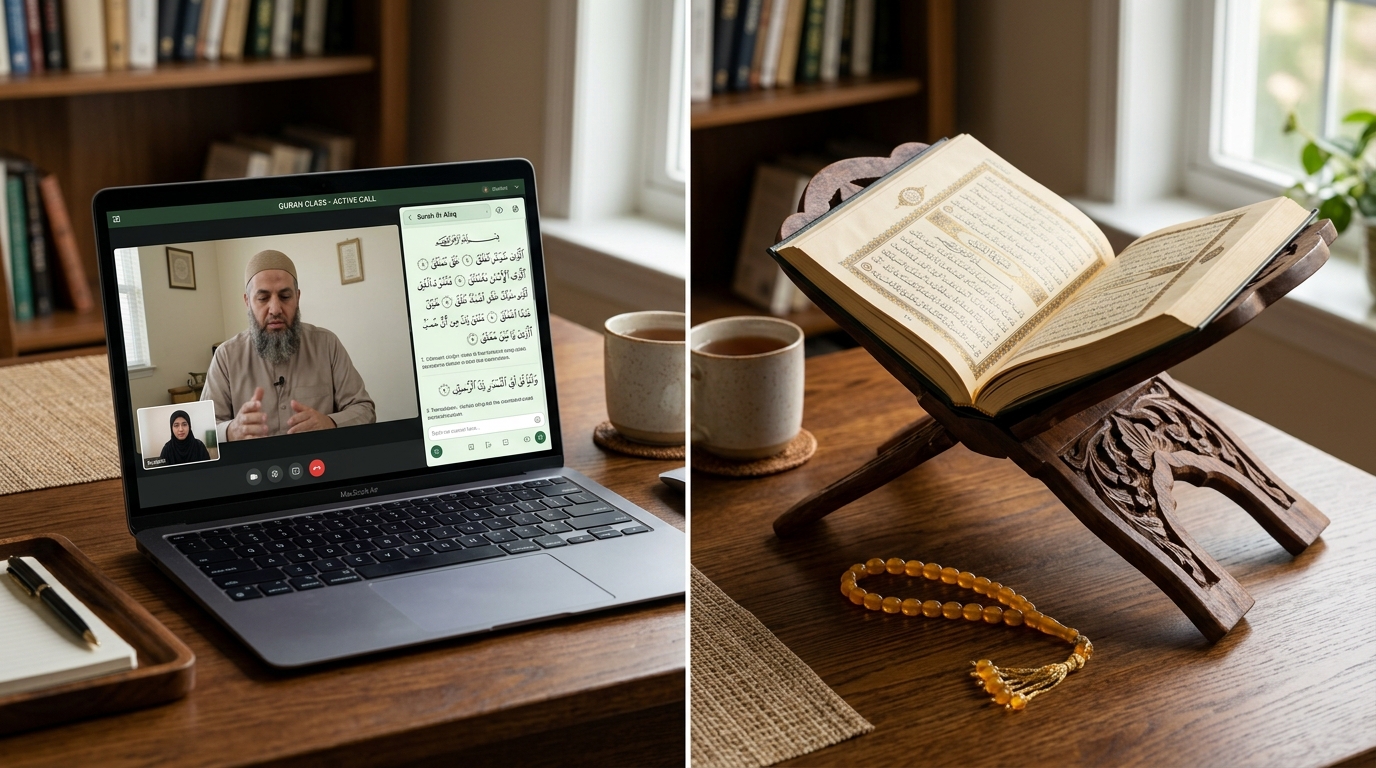
For centuries, Quranic knowledge was transmitted through Talaqqiβ€”sitting knee-to-knee with a qualified teacher who listens, corrects, and verifies your recitation. Online Quran platforms preserve this authentic classical methodology while leveraging digital advantages.

Here is how online Quran classes compare with traditional community madrasahs:

Feature / MetricOnline 1-on-1 Quran ClassesTraditional Local Madrasah
Attention Ratio100% dedicated teacher attentionShared among 15–30 students
Scheduling24/7 flexible slots across all time zonesFixed, rigid evening/weekend hours
Teacher VerificationVetted native Arabic & Ijazah holdersDependent on local volunteer availability
Travel & Commute0 minutes (study comfortably from home)30–60 minutes roundtrip daily commute
Pacing100% customized to the individual studentGroup-paced (fast learners bored, slow left behind)
Safety & OversightParents can observe every live lessonLimited parental observation

The Prophet Muhammad (peace be upon him) emphasized the profound status of Quranic learning: > "The best among you are those who learn the Quran and teach it." (Sahih al-Bukhari 5027)

By removing geographic barriers, online Quran education ensures that every seeker can fulfill this prophetic standard regardless of local limitations.

Step-by-Step Roadmap: How Beginners Learn Quran Online

Step 1: Establish Sincere Intention (Niyyah) & Goals Every Islamic deed is judged by its underlying intention (Innamal a'malu bin-niyyat). Before enrolling in any course, clarify your learning objectives: - Do you want to read the Arabic Quran correctly in daily Salah? - Are you seeking to master beautiful melodic recitation through advanced Tajweed? - Do you wish to memorize short Surahs or embark on full Hifz?

Having explicit, realistic milestones keeps your motivation burning during challenging phonetic lessons.

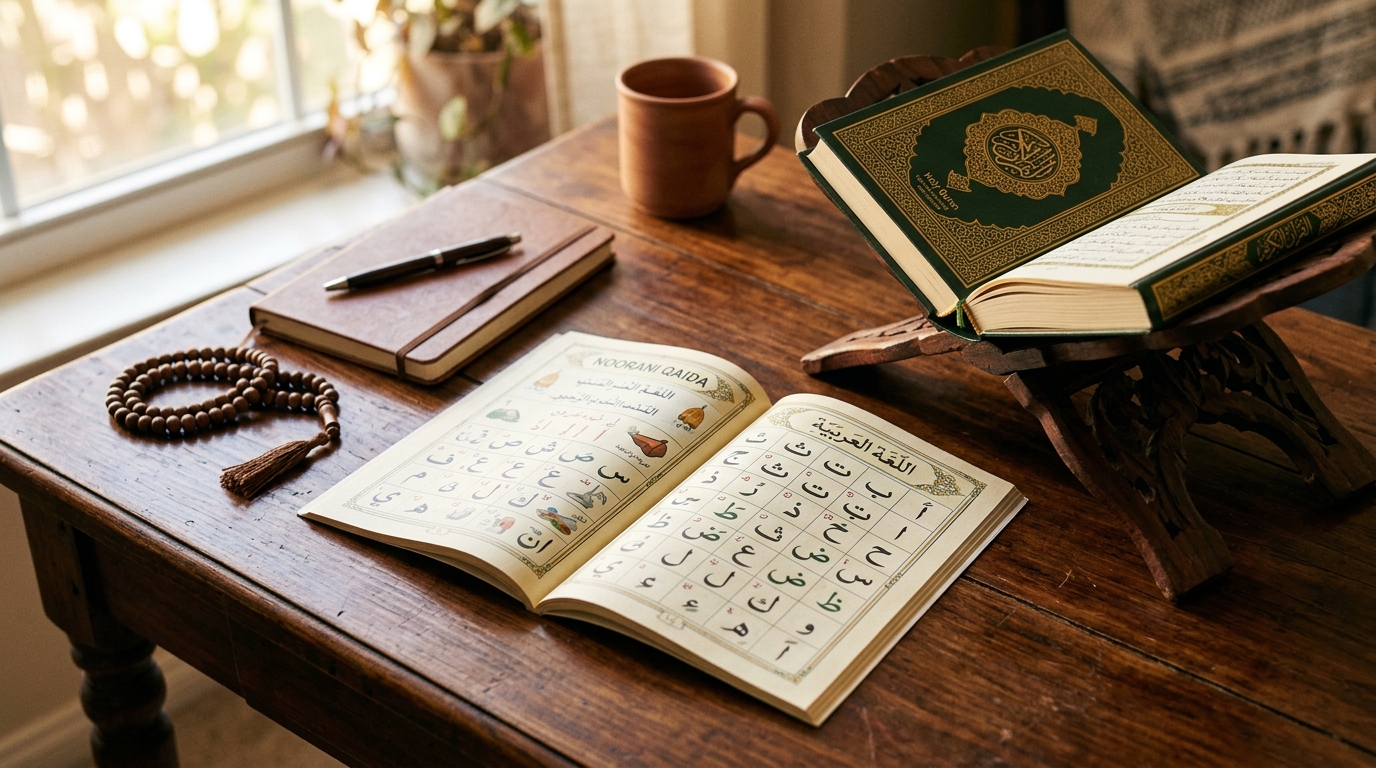
Step 2: Master the Arabic Alphabet & Phonetics via Noorani Qaida You cannot build a sturdy home without deep foundations. For complete beginners, the golden gateway to Quranic literacy is the time-tested Noorani Qaida.

During this initial 3 to 4-month phase, you will master: - Single Letter Recognition (Huroof Mufradat): Identifying all 28 Arabic letters in their isolated shapes. - Compound Letter Forms (Huroof Murakkabat): Recognizing letters when joined in the beginning, middle, and end of words. - Vowel Motions (Harakat): Pronouncing short vowels (Fatha, Kasra, Damma) without stretching. - Tanween and Sukoon: Mastering nunation and resting letters. - Letters of Elongation (Huroof Maddah): Differentiating between short and long vowel durations.

If you are just getting started, explore our structured Learn Noorani Qaida Online curriculum designed specifically for English-speaking beginners.

Step 3: Understand Points of Articulation (Makharij al-Huroof) Arabic is a phonetic language where subtle vocal nuances drastically alter meaning. For instance, confusing the deep throat letter Ψ­ (Haa) with the chest letter Ω‡Ω€ (haa) can turn a sacred phrase into a linguistic mistake.

Your online instructor will guide your vocal tract across the five primary articulation zones: 1. Al-Jawf (The Oral Cavity): Produces elongated vowel sounds (Alif, Waw, Yaa). 2. Al-Halq (The Throat): Six distinct throat letters (Hamzah, Haa, Ayn, Haa, Ghayn, Khaa). 3. Al-Lisan (The Tongue): 18 letters produced from the tip, sides, and base of the tongue. 4. Ash-Shafatain (The Lips): Baa, Meem, Waw, Faa. 5. Al-Khayshoom (The Nasal Passage): Responsible for resonant nasalization (Ghunnah).

To delve deeper into phonetic anatomy, review our specialized guide on Makharij al-Huroof.

Step 4: Transition to Quranic Reading in Juz Amma Once your Qaida foundation is certified, you transition to reading actual scripture from Juz Amma (the 30th section of the Quran). Starting with short, rhythmic chapters such as Surah An-Nas, Surah Al-Falaq, and Surah Al-Ikhlas allows you to apply phonetic rules to the very Surahs you recite in your five daily prayers.

Step 5: Incorporate Foundational Tajweed Rules Tajweed linguistically means "proficiency" or "beautification." Technically, it is giving every single Arabic letter its rightful due and characteristics.

Key beginner Tajweed concepts include: - Rules of Noon Saakin & Tanween: Izhar (clarity), Idgham (merging), Iqlab (conversion to Meem), and Ikhfa (light concealment). - Rules of Meem Saakin: Idgham Shafawi, Ikhfa Shafawi, and Izhar Shafawi. - Qalqalah (Echoing/Bouncing letters): Applied to the letters Ω‚, Ψ·, Ψ¨, Ψ¬, Ψ― (Qutb Jad) when at rest. - Madd Rules: Knowing when to stretch a vowel for 2, 4, 5, or 6 counts.

For a dedicated learning track, check our Online Tajweed Course which breaks down rules with color-coded audio exercises.

Essential Equipment for Seamless Online Quran Lessons

You do not need an expensive recording studio to attend online classes, but having proper tools ensures crystal-clear audio communication:

  • Stable Internet Connection: A minimum download and upload speed of 5 Mbps to prevent video lagging and audio dropouts.
  • Over-Ear Headset with Noise-Cancelling Boom Mic: This is the most crucial piece of hardware. When learning throat letters like Ayn (ΨΉ) or Haa (Ψ­), your tutor must hear tiny acoustic details without room echo.
  • Screen Size Considerations: While a smartphone works in emergencies, a laptop, desktop monitor, or 10+ inch tablet allows you to view Arabic diacritics (tashkeel) with complete clarity.
  • Digital Pen or Touchscreen (Optional): Enables real-time annotation and interactive letter tracing during beginner sessions.

5 Practical Tips to Accelerate Your Quran Learning Progress

  1. Prioritize Frequency Over Length: A 25-minute lesson 4 times per week yields three times better memory consolidation than a single 2-hour marathon on Sunday.
  2. Listen to Murattal Recitations Daily: Immerse your ears in slow, measured recitations by master Qaris such as Sheikh Mahmoud Khalil Al-Husary or Sheikh Muhammad Siddiq Al-Minshawi. Passive listening calibrates your brain to proper rhythmic cadences.
  3. Record and Critique Your Voice: Record yourself reading 3 verses on your smartphone voice memos. Play it back while comparing it to your teacher's demonstration. You will instantly detect timing slips and vowel clipping.
  4. Never Rush Past Mistakes: When your teacher corrects a pronunciation error, repeat the word 5 times correctly before moving to the next Ayah. Fixing a bad habit early takes 30 seconds; untangling ingrained muscle memory after six months takes weeks.
  5. Practice During Salah: Implement newly learned verses in your Sunnah and Nafl prayers. Reciting in sacred prayer cements verses in your heart and mind.

Specialized Programs at QuranHeaven

At QuranHeaven, our mission is to make authentic Quranic education accessible to every family member: - For Young Learners: Engaging, gamified lessons in our Online Quran Classes for Kids. - For Sisters & Reverts: Safe, private female-led environments through Online Quran Classes for Ladies. - For Working Adults: Ultra-flexible evening and weekend schedules via Quran Classes for Adults. - For Hifz Aspirants: Systematic memorization tracks in our Quran Memorization Course.

Take Your First Step Today

The Quran is the living word of Allah, sent down as a mercy, a healing, and an unshakeable guide for mankind. Regardless of your age, your past struggles, or your current schedule, it is never too late to begin reading the divine revelation.

Ready to embark on this life-transforming journey? Book your free trial class today and experience the joy of learning Quran online with our verified, compassionate instructors.

SA

Sheikh Abdullah βœ” Verified Instructor

Lead Islamic Instructor at QuranHeaven

Specializes in accessible Quranic education, structured Tajweed methodologies, and individualized curriculum adaptations for learners worldwide.

Frequently Asked Questions

Yes, absolutely. Most online Quran students start with zero Arabic background. Online Quran academies utilize the Noorani Qaida or Baghdadi Qaida curriculum, which systematically teaches the 28 Arabic letters, their distinct articulation points (Makharij), and vowel attachments before introducing actual Quranic verses.
All you need is a reliable internet connection (at least 5 Mbps), a computer, tablet, or smartphone, and a headset with a microphone. A quiet, distraction-free study space enhances focus during live pronunciation correction.
With 3 to 4 one-on-one sessions per week and 15 minutes of daily personal revision, an adult beginner typically completes Noorani Qaida within 3 to 4 months and begins reading Quranic chapters from Juz Amma fluently within 6 to 8 months.
Yes. Islamic scholars agree that digital Talaqqi (direct oral transmission and correction between teacher and student) fulfills the traditional Sunnah requirement of learning Quran directly from certified teachers carrying authentic Ijazah credentials.
Found this guide helpful?
← Back to Blog
πŸ’¬
✨ Enroll Now πŸ“ž Call Us πŸ’¬ WhatsApp