- Beginner Quran education must strictly follow the chronological hierarchy: single letters, compound forms, short vowels (Harakat), and long vowels (Madd).
- Skipping foundational phonetics to jump straight into reading verses is the number one cause of long-term recitation defects.
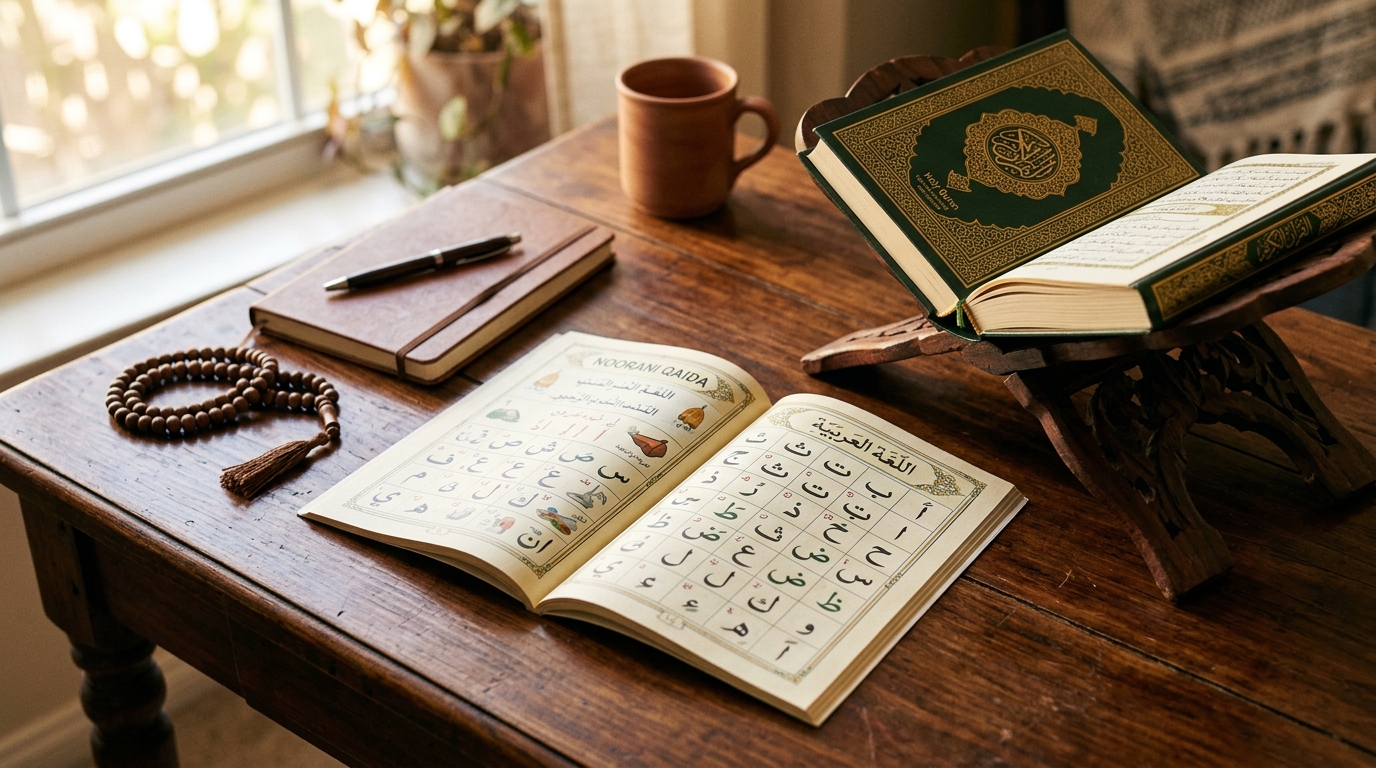
- Noorani Qaida provides the universal phonetic blueprint that equips students to read any page of the Quran independently.
- The first Surahs memorized should be the short, high-frequency prayer chapters of Juz Amma (Surah Al-Fatiha, Al-Ikhlas, Al-Falaq, and An-Nas).
When a beginner decides to learn the Quran, the sheer scope of the task can feel dizzying. The Quran contains 114 Surahs, 6,236 Ayahs, and over 77,000 words written in classical Arabic script adorned with unfamiliar diacritical symbols. Eager students often open a copy of the Mushaf, try to sound out verses, and quickly become discouraged by the linguistic complexity.
The secret to successful Quran learning lies in sequencing. In the classical Islamic tradition, scholars developed a precise, cumulative curriculum designed to take a student from zero knowledge to confident, independent recitation.
If you are wondering: "What should I learn first in Quran classes?" this guide outlines the exact, time-tested chronological hierarchy.
In beginner Quran classes, you must learn the foundational elements in this exact sequence: first, the 28 isolated Arabic letters and their Makharij (pronunciation points); second, connected letter shapes; third, short vowels (Harakat) and Tanween; fourth, Sukoon and Shaddah rules via Noorani Qaida; and finally, Surah Al-Fatiha followed by the short chapters of Juz Amma.
The Complete 6-Stage Beginner Learning Sequence
Every proficient Qari who has ever recited the Quran with captivating beauty began at Stage 1. Do not skip steps; each level serves as the essential bedrock for the next.
| Stage | Focus Area | Core Material | Typical Duration | Milestone Goal |
|---|---|---|---|---|
| Stage 1 | Single Alphabet & Articulation | Huroof Mufradat | 2–3 Weeks | Pronounce all 28 letters with distinct Makharij |
| Stage 2 | Joined Letters & Shapes | Huroof Murakkabat | 2–3 Weeks | Recognize letters in beginning, middle & ending forms |
| Stage 3 | Vowels & Diacritics | Harakat & Tanween | 4–6 Weeks | Read short vowels (Fatha, Kasra, Damma) without dragging |
| Stage 4 | Advanced Phonetic Marks | Sukoon, Shaddah, Madd | 4–6 Weeks | Master resting marks, consonant doubling, and elongation |
| Stage 5 | Foundational Tajweed | Basic Recitation Rules | 6–8 Weeks | Apply Ghunnah, Qalqalah, and basic Noon Saakin rules |
| Stage 6 | Juz Amma Application | Surah Al-Fatiha & Short Surahs | Ongoing | Recite prayer Surahs with fluent, melodic accuracy |
---
Stage 1: Single Letter Recognition & Accurate Makharij
Arabic consists of 28 consonants. Unlike English, where letters frequently change sounds (e.g., 'c' in "cat" vs "city"), Arabic letters maintain absolute phonetic consistency. However, Arabic contains guttural and emphatic sounds that do not exist in Germanic or Romance languages.
In your first lessons, you must master: - Differentiating similar-sounding letters: ت (Taa) vs ط (Taa), ذ (Dhal) vs ز (Zay) vs ظ (Dhaa), and س (Seen) vs ص (Saad). - Sounding throat letters correctly: ع (Ayn) and ح (Haa). - Avoiding English phonetic substitutions (e.g., pronouncing ض as a soft English 'd' instead of the unique emphatic Arabic Daad).
Explore our dedicated Makharij al-Huroof Guide for detailed diagrams of articulation zones.
Stage 2: Joined Letter Shapes (Al-Murakkabat)
Arabic is written in cursive script from right to left. Letters change their visual appearance depending on their position in a word: - An isolated ب (Baa) looks like a wide boat with a dot underneath. - At the start of a word, it retains only its initial hook: بـ. - In the middle, it connects on both sides: ـبـ. - At the end, it returns to its full boat shape: ـب.
During this stage, students learn to identify letters by their defining markers—specifically the number and placement of dots (e.g., 1 dot below for Baa, 2 dots above for Taa, 3 dots above for Thaa).
Stage 3: The Movement Vowels (Al-Harakat) and Tanween
In Arabic, words are not written with standalone vowel letters; instead, small diacritical symbols are placed above or below consonants to indicate short vowel movements: - Fatha ( َ ): A diagonal stroke above the letter producing a short "ah" sound. - Kasra ( ِ ): A diagonal stroke below the letter producing a short "ee" sound. - Damma ( ُ ): A small curl above the letter producing a short "oo" sound.
Critical Rule for Beginners: Harakat are quick, sharp sounds. A frequent beginner mistake is dragging a Fatha into an elongated Alif. Your teacher will train your tongue to pronounce them briskly.
Following Harakat, you learn Tanween (double vowels: Fathatain, Kasratain, Dammatain), which adds an unwritten 'N' sound to the end of nouns (an, in, un).
Stage 4: Sukoon, Shaddah, and Maddah
Once vowels are fluid, the student tackles the architectural mechanics of Arabic phonology: - Sukoon (Jazm): Indicates that a letter has no vowel movement; it is silent and connects to the preceding moving letter. - Shaddah (Tashdeed): A small 'w'-shaped mark indicating that a letter is doubled—the first instance is pronounced with Sukoon, followed immediately by a vowel movement with strong emphasis. - Huroof Maddah (Elongation Letters): Learning when to stretch a vowel for 2 counts (Alif preceded by Fatha, Waw preceded by Damma, Yaa preceded by Kasra).
All of these principles are taught step-by-step in our premier Learn Noorani Qaida Online course.
Stage 5: The First Essential Surahs for Daily Salah
Once a student can read connected words, they immediately begin applying their skills to the most sacred prayers.
The memorization priority is: 1. Surah Al-Fatiha (The Opening): Memorized and recited with meticulous Tajweed perfection, as it is a pillar of every unit (Rak'ah) of Salah. 2. Surah Al-Ikhlas (Purity of Faith): Equal to one-third of the Quran in virtue. 3. Al-Mu'awwidhatayn (Surah Al-Falaq & Surah An-Nas): The twin Surahs of spiritual protection. 4. Surah Al-Kawthar & Surah An-Nasr: Short, beautiful chapters that reinforce rhythmic confidence.
Stage 6: Foundational Tajweed Rules
Before reading continuous multi-page passages from the Mushaf, you will learn basic Tajweed rules: - Ghunnah: Holding a nasal sound on Noon and Meem when they bear a Shaddah (نّ, مّ) for 2 counts. - Qalqalah: Creating a crisp bouncing echo on resting letters ق, ط, ب, ج, د. - Stopping Rules (Waqf): Knowing how to properly pause at the end of verses and how vowel endings transform upon stopping.
For in-depth training on beautiful recitation, see our Online Tajweed Course.
3 Critical Beginner Traps to Avoid
- Relying on English Transliteration: Never use romanized text (e.g., "Bismillahir-Rahmanir-Raheem" in English letters) to read Quran. English letters cannot represent Arabic sounds like Haa, Ayn, Saad, or Dhaa. Reading transliteration hardwires atrocious pronunciation errors that are nearly impossible to unlearn later.
- Prioritizing Speed Over Accuracy: Reading half a page with pristine Makharij and zero mistakes is infinitely more pleasing to Allah and beneficial to your memory than rushing through five pages full of phonetic blunders.
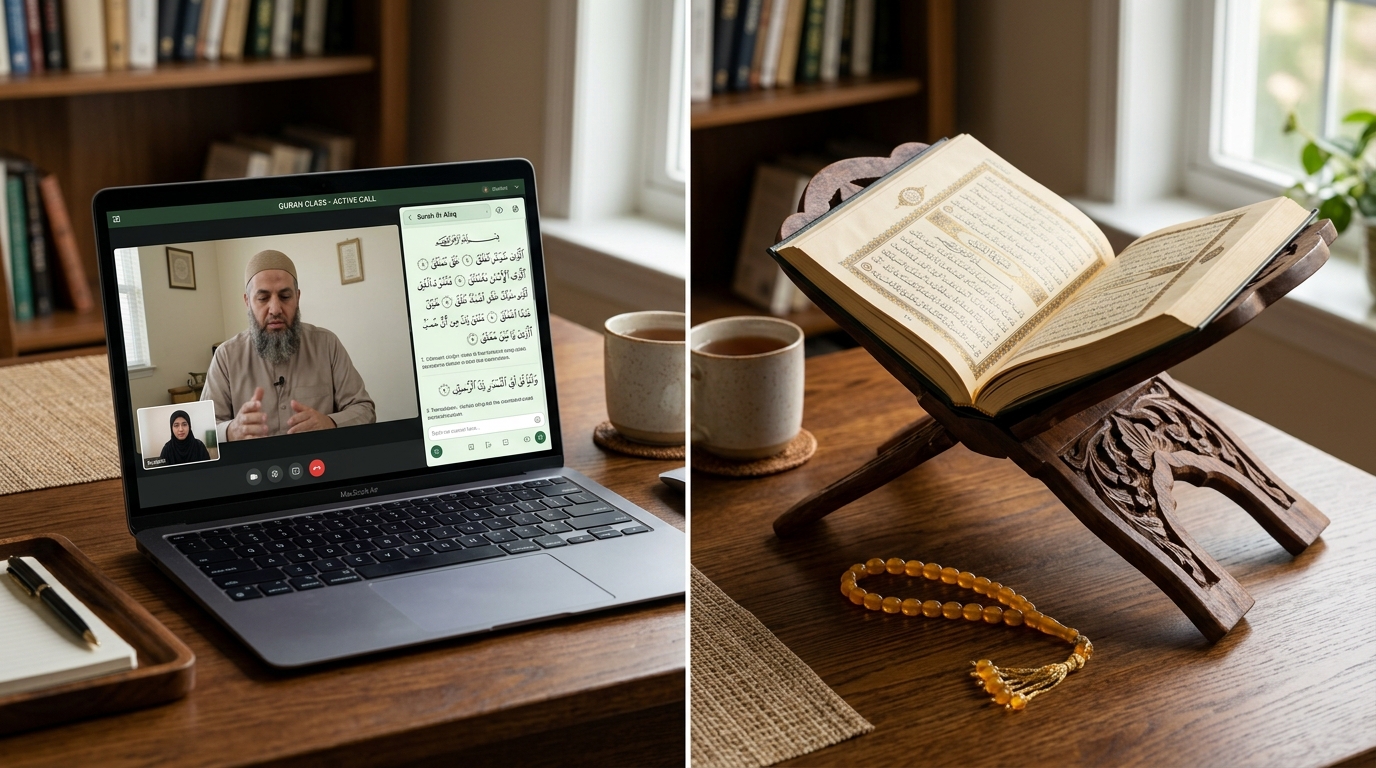
- Self-Teaching Without a Verified Mentor: You cannot learn Quran solely through YouTube videos or smartphone apps. The Quran is an oral tradition. You require a live teacher to hear your voice, identify subtle tongue slips, and demonstrate immediate correction.
Start Your Quranic Education the Right Way
Every journey of a thousand miles begins with a single step. By following this proven, step-by-step roadmap under certified guidance, learning to read the Holy Quran will feel intuitive, deeply enjoyable, and spiritually illuminating.
Discuss a suitable starting point for your own skills. Enroll in a free trial class at QuranHeaven and master your first letters with our caring tutors.