- Pronunciation issues in children stem primarily from phonetic interference from English or native Western languages.
- The most common childhood errors involve confusing throat letters (Ayn vs Alif, Haa vs Haa) and mixing heavy letters with light letters (Taa vs Taa, Seen vs Saad).
- A 5-minute daily vocal workout using isolated syllable repetition and mouth placement awareness produces rapid muscle memory correction.
- Gentle visual and tactile feedback (like feeling throat vibrations or checking breath on a hand) helps children correct sounds without anxiety.
Many dedicated Muslim parents notice a recurring dilemma: their child diligently attends Quran lessons, completes assigned pages, and can even recite several short Surahs from memory—yet their recitation sounds flat, anglicized, and full of pronunciation slips.
Letters like ع (Ayn) sound like an English "Ah." The sharp throat letter ح (Haa) gets confused with the soft chest letter هـ (Haa). And heavy letters like ص (Saad) end up sounding identical to light letters like س (Seen).
Parents often wonder: "Is my child tone-deaf? Why can't they hear the difference? How can I help them improve their Quran reading pronunciation without causing tears or frustration?"
Pronunciation challenges in children are completely normal. They are not a sign of low intelligence or spiritual lack; they are simply the result of phonetic muscle interference. With the right diagnostic awareness and playful vocal exercises, any child can develop crisp, beautiful, authentic Arabic pronunciation.
To improve your child's Quran reading pronunciation, diagnose specific phonetic pairs (e.g., Ayn vs Alif, heavy vs light letters), use multisensory physical cues (feeling throat vibrations, checking breath on the palm), and conduct a daily 5-minute targeted vocal drill. Partnering with a live 1-on-1 Ijazah-certified tutor ensures immediate, gentle acoustic feedback.
The Diagnostic Matrix: Top 5 Childhood Pronunciation Errors
Before you can fix an error, you must identify exactly where the articulation breakdown is occurring:
| Error Type | Confused Letter Pair | What the Child Says ❌ | What It Should Sound Like ✅ | Correction Method |
|---|---|---|---|---|
| 1. The Throat Squeeze | ع (Ayn) vs ء (Hamzah) | Pronounces 'Ayn as flat English "Ah" | Deep squeeze of the middle throat muscles | The "Doctor's Tongue Depressor" drill |
| 2. The Breath Confusion | ح (Haa) vs هـ (Haa) | Pronounces Haa like soft English "H" (hat) | Sharp, raspy exhale from middle of throat | The "Fogging the Mirror" exercise |
| 3. Heavy vs Light Letters | ص (Saad) vs س (Seen) | Makes Saad sound thin like "Sun" | Grand, full-mouth sound with back tongue raised | The "Smile vs O-Shape" technique |
| 4. The Emphatic Taa | ط (Taa) vs ت (Taa) | Pronounces Taa like English "Tea" | Heavy, thick sound hitting roots of teeth | The "Full Mouth Echo" method |
| 5. The Bouncing Slur | ق, ط, ب, ج, د (Qalqalah) | Swallows resting letters silently | Crisp, springy echoing release | The "Rubber Ball Bounce" visual |
---
3 Sensory Exercises to Master Difficult Letters at Home
Children learn physical skills through tangible sensations. Use these creative, playful drills at home:
Exercise 1: "Fogging the Cold Mirror" (for Letter ح - Haa)
The sharp Arabic letter ح (Haa) is produced by constricting the epiglottis in the middle of the throat, pushing out a clean, unvoiced friction sound. - Hand your child a small handheld mirror or smartphone screen. - Instruct them: "Imagine you are outside in the winter snow and you want to fog up the glass with your warm breath: 'Haaaaa!'" - When they exhale cleanly from the throat, moisture coats the glass. - Then say: "MashaAllah! Now add the Arabic vowel to that exact foggy breath: 'Haa... Hee... Hoo!'" - This transforms an abstract phonetic rule into an instant physical achievement.
Exercise 2: "The Hand on the Adam's Apple" (for Letter ع - Ayn)
The letter ع (Ayn) is unique to Arabic and Semitic languages. It requires squeezing the pharyngeal muscles. - Have your child gently place two fingers on the center of their neck (the Adam's apple area). - Tell them to swallow saliva: notice how the neck muscles tighten and lift upward? - Now, ask them to mimic a baby crying or a sheep bleating ("Aaaayn... Aaaayn!") while holding that gentle swallow squeeze. - They will immediately feel the physical contraction under their fingers, teaching their brain which muscle group to activate.
Exercise 3: "Smile vs Balloon" (for Heavy Letters - Tafkheem)
Distinguishing heavy letters (خ, ص, ض, غ, ط, ق, ظ - Khussa Daghtin Qiz) from light letters is the hallmark of skilled recitation. - Light Letters (Seen, Taa, Dhaal): Tell your child: "Give me a wide, happy smile! See how your lips spread out? That makes the letter light and sweet: 'Saaa... Taaa...'" - Heavy Letters (Saad, Taa, Dhaa): Tell your child: "Now fill your cheeks with air like a round balloon! Raise the back of your tongue to the ceiling of your mouth: 'Sooo... Tooo...'" - Alternating between smiling and rounding mouth shapes creates sharp acoustic contrast.
Explore our comprehensive Makharij al-Huroof Guide for full anatomical diagrams.
---
The Daily 5-Minute Vocal Workout Routine
Do not overwhelm your child with hours of drilling. Use this simple 5-minute daily warm-up before their regular reading practice:
- Minute 1: Throat Warming. Practice 5 clean repetitions of 'A-I-'U (Hamzah) followed by 5 repetitions of 'Aa-'Ee-'Oo (Ayn).
- Minute 2: The Foggy Exhale. Practice 5 repetitions of Haa-Hee-Hoo (throat Haa) vs haa-hee-hoo (chest haa).
- Minute 3: The Heavy/Light Tug-of-War. Alternate 5 pairs of contrasting words: Saad vs Seen, Taa vs Taa, Daad vs Daal.
- Minute 4: Qalqalah Bouncing. Recite Surah Al-Falaq, deliberately emphasizing the springy bounce on the ending letters (ق, ب, د).
- Minute 5: High Praise & Hug. Conclude with energetic, sincere validation: "MashaAllah! Your throat letters sounded like a real Qari today!"
How Live 1-on-1 Tutors Ensure Rapid Correction
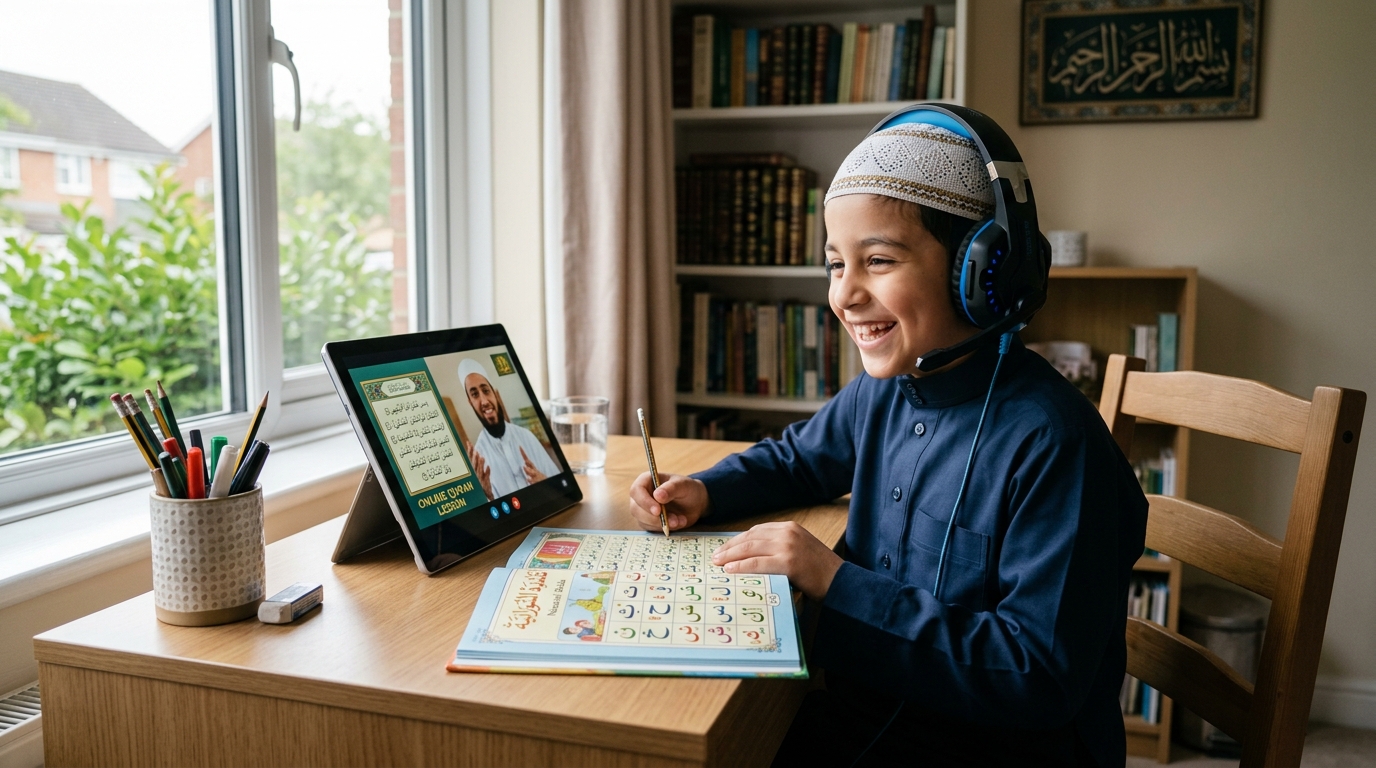
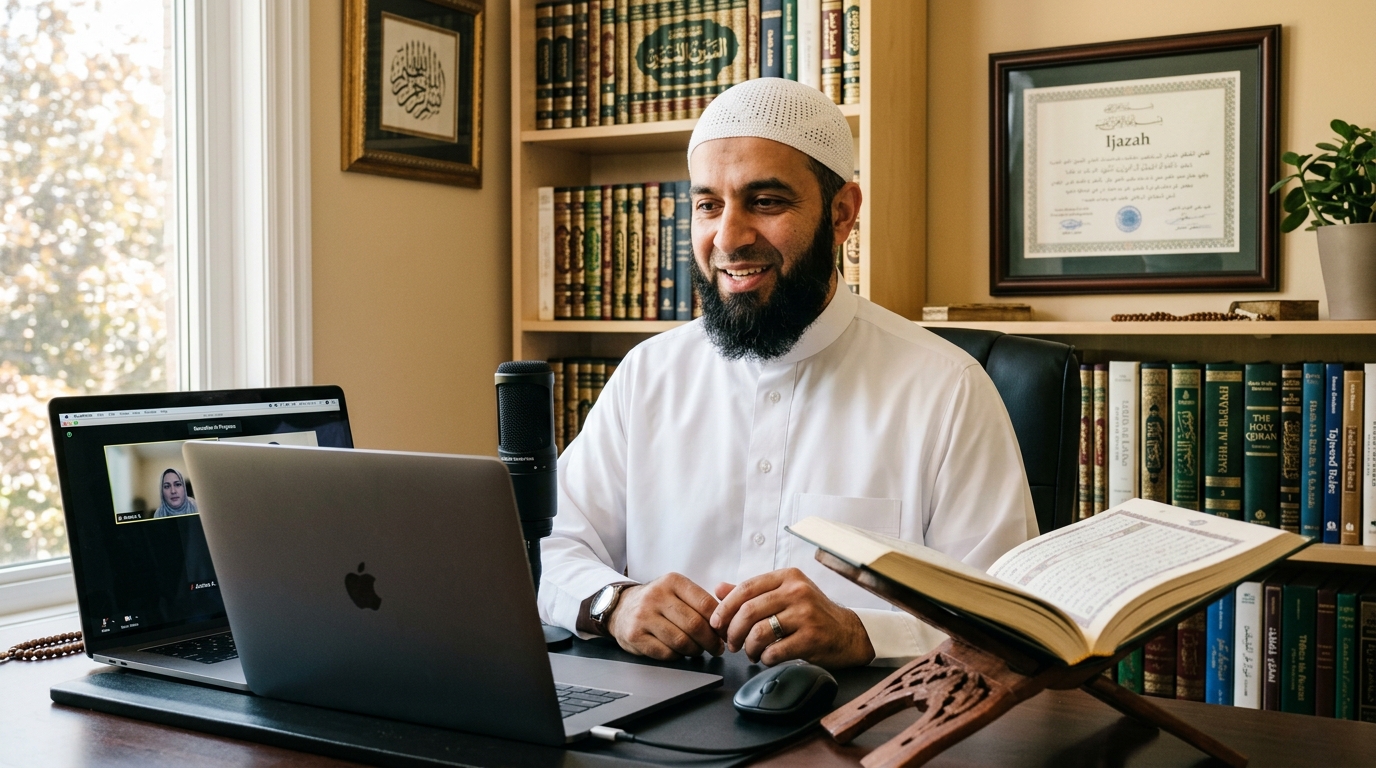
While home exercises provide valuable reinforcement, nothing replaces a master teacher's live ear: - In our Online Quran Classes for Kids, instructors use close-up webcams to show the exact shape of their lips and tongue. - The tutor immediately stops an erroneous sound before the child repeats it three times, preventing incorrect muscle memory from taking root. - Sisters and young girls can study under certified female scholars through our Online Quran Classes for Ladies. - For students ready to refine advanced recitation, our Online Tajweed Course provides systematic mastery.
Conclusion: Patience Builds Beautiful Voices
Every child's tongue is capable of reciting the Holy Quran with divine beauty. It requires patience, gentle guidance, and daily encouragement.
When your child recites a difficult verse correctly, their face illuminates with pride, and their heart draws closer to the words of Allah.
Give your child the gift of pristine pronunciation. Book a free 1-on-1 trial class at QuranHeaven today and let our expert teachers unlock your child's vocal potential.