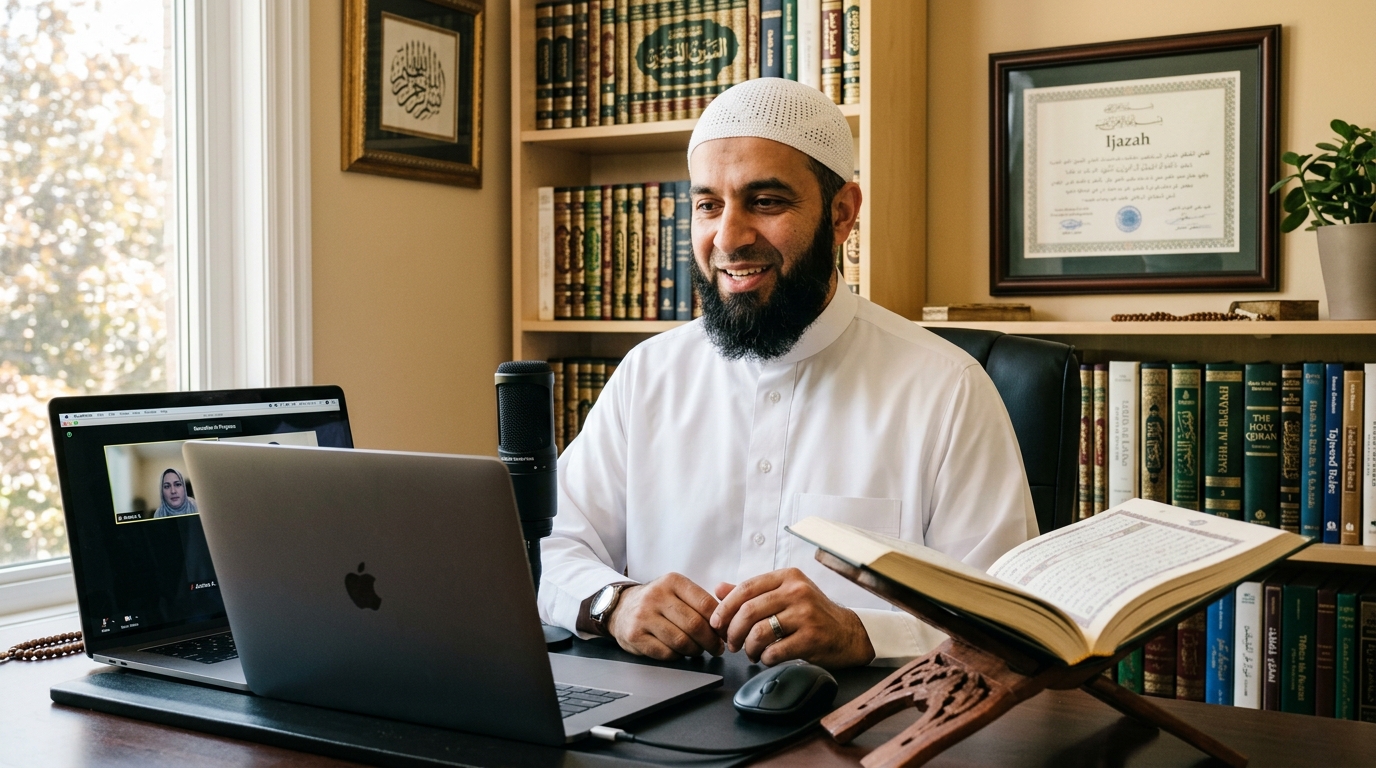
- An authentic Quran teacher must possess an authentic Ijazah with a connected chain of transmission (Sanad) tracing back to the Prophet Muhammad (PBUH).
- Patience and child-friendly communication skills are just as vital as Quranic knowledge when teaching young children.
- Evaluate how the teacher handles student mistakes during the free trialβpraise should outweigh harsh criticism.
- Always verify platform safety protocols, session recording policies, and background check standards before enrolling.
Choosing a Quran teacher for your child is one of the most consequential decisions you will ever make as a Muslim parent. A great Quran teacher does not merely impart the mechanics of reading Arabic; they shape your child's emotional relationship with Allah's words, build their moral character (Akhlaq), and nurture a lifelong love for Islam.
Conversely, an impatient, harsh, or unqualified tutor can turn Quran lessons into an agonizing chore, causing children to resent the very book meant to bring light to their hearts. With hundreds of online tutoring platforms claiming to be the "best," how can discerning parents separate genuine scholars from unqualified tutors?
This parent's evaluation guide provides a rigorous checklist to ensure your child learns under the finest educators.
To choose the best online Quran teacher for your child, verify three non-negotiable pillars: authentic Ijazah certification with Tajweed mastery, demonstrated child-pedagogy skills (patience, warmth, and interactive methods), and fluent English communication. Test their demeanor during a live trial class, ensuring they praise effort, correct mistakes gently, and keep lessons engaging.
The 7-Point Teacher Evaluation Rubric
Before committing your child's weekly schedule and your hard-earned finances, evaluate prospective instructors against this professional rubric:
| Evaluation Criteria | High-Quality Educator Standard | Red Flag / Warning Sign |
|---|---|---|
| 1. Authentic Certification | Holds verified Ijazah Mutassilah (connected chain) | Vague claims of "having memorized Quran" without proof |
| 2. Tajweed Precision | Crystal-clear articulation of all Makharij & Sifaat | Muffled sounds, skipping Ghunnah, or slurring endings |
| 3. Pedagogical Patience | Warm demeanor; uses encouragement & positive reinforcement | Sighing, raising voice, or expressing irritation at mistakes |
| 4. Communication Fluency | Fluent in English; understands Western youth culture | Heavy language barrier leading to student confusion |
| 5. Technical Professionalism | Dedicated headset, quiet room, zero background noise | Street noise, family chatter, barking dogs in background |
| 6. Structured Curriculum | Follows established book (e.g., Noorani Qaida) | Random, unorganized verse selection without textbook |
| 7. Punctuality & Reliability | Logs in 2 minutes early; delivers full scheduled time | Frequent cancellations, late logins, or checking phone |
For a deeper dive into our institutional standards, read How We Verify Teachers and understand our Teaching Methodology.
Pillar 1: Understanding Ijazah & Sanad Credentials
In Islamic scholarship, pedigree matters. An Ijazah is not a generic participation certificate printed from an online portal; it is a formal license of mastery.
When evaluating a tutor's credentials: - Ask for their Sanad: An authentic Sanad traces the teacher's recitation through their Sheikh, going generation by generation back to the Companions (Sahabah) and the Prophet Muhammad (peace be upon him). - Verify the Riwayah: The vast majority of the Muslim world recites according to the transmission of Hafs 'an 'Asim via the Shatibiyyah pathway. Ensure your child's tutor is certified in this transmission. - Continuous Knowledge: Experienced teachers frequently hold multiple Ijazahs in classical Tajweed texts like Tuhfat al-Atfal and Al-Jazariyyah.
Learn more about the history and importance of certification in our article Understanding Ijazah and Sanad.
Pillar 2: Child Psychology and Gentle Pedagogy
Having encyclopedic knowledge of Tajweed rules does not automatically make someone a great children's teacher. Teaching a 6-year-old in Chicago or London requires vastly different pedagogical skills than teaching an adult seminar at Al-Azhar University.
Look for these essential teaching behaviors during your trial: - The "Mistake Sandwich" Technique: When the child mispronounces a letter, an exceptional teacher first praises effort ("Excellent attempt on that word!"), gently isolates the specific sound ("Now listen closely to my tongue: 'Thaa', not 'Saa'"), and concludes with encouragement ("MashaAllah, you nailed it!"). - Gamification and Energy: Watch whether the teacher uses virtual stars, high-fives on camera, or short interactive games to celebrate completing a difficult Qaida line. - Reading Child Fatigue: If an 8-year-old child's focus wanes after 18 minutes of intensive reading, an insightful teacher pauses for 60 seconds to share a 1-minute story about the Prophet's companions or stretch, then refocuses.
Pillar 3: Language and Cultural Relatability
Many Muslim parents living in the West hire overseas tutors who speak limited English. While their intentions are pure, the resulting language barrier often stunts the child's growth: - When a child asks: "Teacher, why does this letter have a small zero above it?" a teacher with weak English cannot explain the concept of Sukoon clearly. - Children can feel emotionally disconnected from instructors who cannot relate to their everyday school experiences, hobbies, or cultural context.
At QuranHeaven, our instructors undergo thorough English language screening so they can effortlessly converse, explain complex Arabic phonetic mechanics, and inspire young minds.
Pillar 4: Gender Preferences and Role Modeling
As children enter pre-teen years, gender dynamics in education become increasingly significant: - Young Boys: Benefit tremendously from energetic, disciplined male Qaris who model masculine Islamic piety, proper posture, and confident public recitation. - Young Girls: Frequently thrive under nurturing, Ijazah-certified female tutors who serve as inspiring spiritual mentors. For families seeking female instructors, explore our dedicated Online Quran Classes for Ladies department.
Questions Every Parent Should Ask During the Free Trial Class
Do not be shy about interviewing your prospective tutor. Consider asking: 1. "Which formal Tajweed curriculum do you use to transition a beginner into the Quran?" 2. "How do you keep my child accountable for practicing between our scheduled lessons?" 3. "How many years of experience do you have teaching children in this specific age bracket?" 4. "If my child struggles with a particular sound like Ayn (ΨΉ) or Saad (Ψ΅), what specialized exercises will you use to help them?" 5. "How will you keep me informed of my child's monthly milestones and areas needing improvement?"
Red Flags That Mean You Should Walk Away Immediately
If you observe any of the following behaviors, cancel the classes immediately and find another teacher: - Shaming or Ridicule: Saying things like "Why don't you know this yet?" or comparing the student unfavorably to other children. - Rushing through Qaida: Attempting to put a child into the Holy Quran before they can independently read connected Arabic letters with diacritics. - Distracted Teaching: The tutor looking away from the camera, typing on another keyboard, eating during lessons, or taking personal phone calls. - Unregulated Communication: Any tutor asking to message your child directly outside the monitored academy portal.
The QuranHeaven Standard of Excellence
At QuranHeaven, we reject 95% of tutor applicants so that you only receive the top 5%: - Every instructor holds verified Ijazah credentials from premier Islamic institutions. - Comprehensive background checks and continuous pedagogical monitoring. - Safe, transparent digital classrooms where parents can observe any session. - Tailored tracks for general learners, advanced Hifz students, and children with special learning needs like ADHD or Autism.
Invest in Your Child's Akhirah Today
A dedicated, loving Quran teacher is a blessing whose lessons echo throughout your child's adult life and reward you in the Hereafter.
Give your child the mentor they deserve. Book a free trial class with our verified tutors today and witness the difference compassionate Islamic education makes.