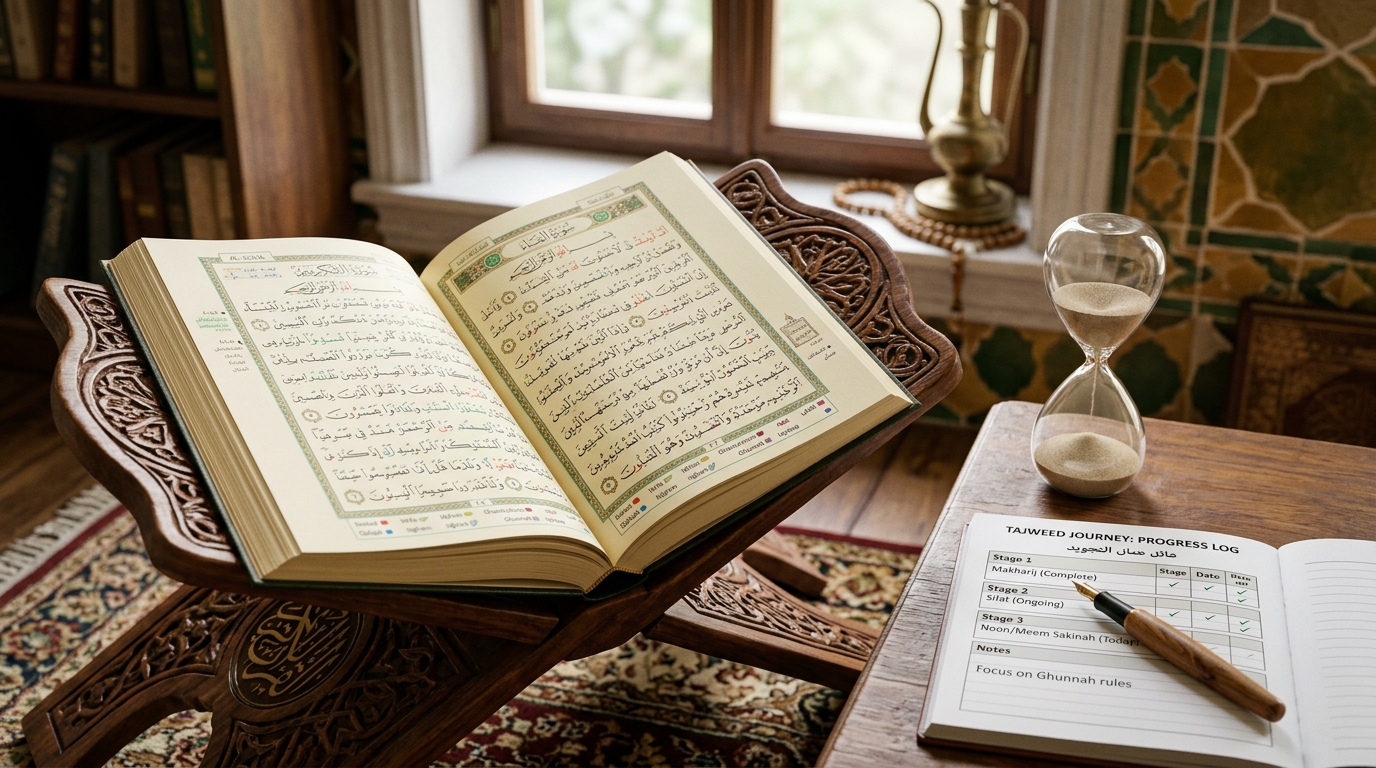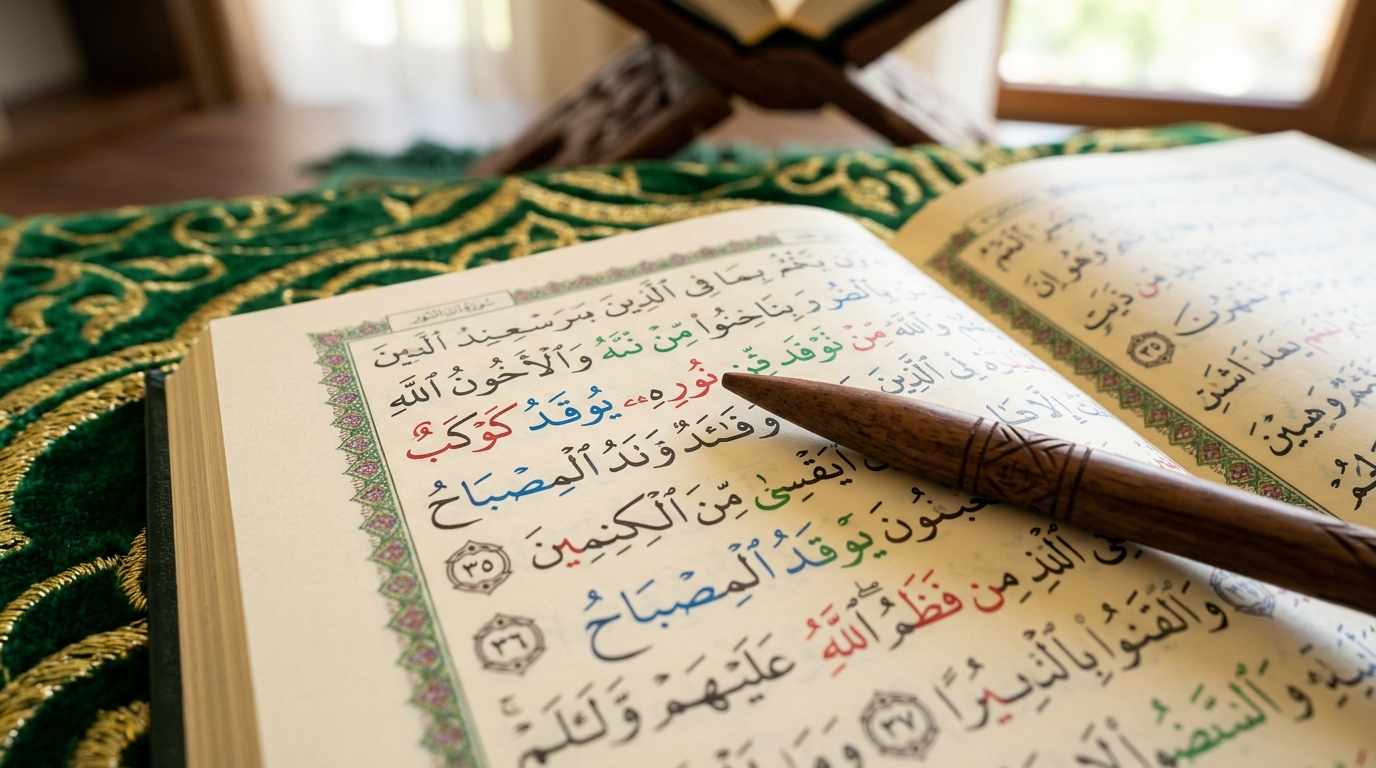
- Tajweed linguistically means 'proficiency' or 'beautification'; technically, it is giving every Arabic letter its rightful pronunciation and characteristics.
- Reading with basic Tajweed to avoid major errors (Lahn Jali) that corrupt meaning is an individual obligation (Fard Ayn) upon every Muslim.
- Subtle mispronunciations drastically corrupt meanings: confusing Qalb (heart) with Kalb (dog), or Alim (knower) with Aleem (painful).
- The Holy Quran was revealed with Tajweed orally; reciting it with measured cadence (Tartil) fulfills a direct command from Allah in Surah Al-Muzzammil.
When listening to a world-renowned Qari recite the Holy Quran, the listener is immediately captivated by the hypnotic, rhythmic beauty of the recitation. The measured cadence, the resonant nasal hums, the crisp echoing stops, and the harmonious stretching of vowels touch the deepest corners of the human soul.
Behind this divine acoustic beauty lies a precise, sacred science: Ilm al-Tajweed (The Science of Tajweed).
Yet many Muslims wonder: What exactly is Tajweed? Is it merely optional ornamental singing, or is it a mandatory Islamic duty? And why does proper pronunciation matter so profoundly when reading the Quran?
This comprehensive guide explores the linguistic, theological, and practical significance of Tajweed in the life of every believer.
Tajweed is the Islamic science governing the precise pronunciation and acoustic attributes of every Arabic letter in the Quran. It is vitally important because minor mispronunciations in Arabic drastically alter theological meanings (e.g., turning "All-Knowing" into "Painful"). Applying basic Tajweed to avoid major errors is an individual Islamic obligation (Fard Ayn) commanded directly by Allah.
Linguistic vs. Technical Definition of Tajweed
To understand Tajweed, scholars distinguish between its linguistic roots and its technical application: - *Linguistic Meaning (Lughatan): Derived from the Arabic root Jawwada (جَوَّدَ), meaning "to beautify," "to perfect," or "to make excellent." - Technical Islamic Meaning (Istilahatan): Giving every single Arabic letter its rightful point of articulation (Makraj) and its inherent and temporary phonetic characteristics (Sifaat*) without exaggeration or carelessness.
Allah Himself commanded the application of Tajweed in the Holy Quran: > "And recite the Quran with measured, rhythmic recitation (Tartil)." (Surah Al-Muzzammil 73:4)
When asked about the meaning of Tartil in this verse, the fourth Caliph, Ali ibn Abi Talib (may Allah be pleased with him), famously defined it as: > "Tartil is the beautification of the letters (Tajweed al-Huroof) and the knowledge of stopping places (Ma'rifat al-Wuqoof)."
---
The Dangerous Consequences of Ignoring Tajweed
Arabic is an exquisitely precise Semitic language. Unlike English, where mispronouncing an accent rarely alters a sentence's basic meaning, confusing similar-sounding Arabic letters can completely reverse sacred theological truths.
Consider these alarming real-world examples:
| Correct Arabic Word | Intended Quranic Meaning | Mispronounced Word | Accidental Corrupted Meaning |
|---|---|---|---|
| قَلْب (Qalb - with heavy deep Qaf) | "Heart" (spiritual center) | كَلْب (Kalb - with light Kaf) | "Dog" |
| عَلِيم ('Aleem - with throat Ayn) | "All-Knowing" (Attribute of Allah) | أَلِيم (Aleem - with soft Hamzah) | "Painful / Tormenting" |
| عَصَى ('Asaa - with heavy Saad) | "He disobeyed" | عَسَى ('Asaa - with light Seen) | "Perhaps / It may be" |
| خَلَقَ (Khalaqa - with heavy Khaa & Qaf) | "He created" | حَلَقَ (Halaqa - with throat Haa) | "He shaved / trimmed" |
| الرَّحْمَٰن (Ar-Rahmaan - with clear throat Haa) | "The Most Merciful" | Ar-Rahmaan (with chest Haa) | Corrupts divine attribute into nonsense |
Imagine standing in daily Salah intending to praise Allah as Al-'Aleem (The All-Knowing), but due to poor Tajweed, addressing Him as Al-Aleem (The Painful)! This is why classical scholars categorized recitation errors into two distinct types.
---
The Two Types of Recitation Errors (Al-Lahn)
In the science of Tajweed, mistakes are classified based on their severity:
1. Lahn Jali (Clear / Major Error) — ⚠️ HARAM (Prohibited)
A severe, obvious phonetic blunder that alters letters, vowels, or meanings: - Swapping one letter for another (e.g., saying ت instead of ط, or س instead of ص). - Changing a vowel (Harakah)—for example, reciting An'amtu 'alayhim ("I have blessed them") instead of An'amta 'alayhim ("You have blessed them") in Surah Al-Fatiha! - Adding or dropping a letter.
Islamic Ruling: Committing Lahn Jali intentionally, or through careless negligence without attempting to learn, is considered sinful by unanimous scholarly consensus, and invalidates prayer if it alters meaning in Surah Al-Fatiha.
2. Lahn Khafi (Hidden / Minor Error) — ⚠️ MAKROOH (Disliked)
A subtle acoustic imperfection known only to trained Tajweed scholars: - Holding a Ghunnah (nasal sound) for 1 count instead of the required 2 counts. - Failing to produce a crisp Qalqalah echo on resting letters. - Stretching a Madd for 3 counts instead of 4 or 5 counts.
Islamic Ruling: Does not invalidate prayer or alter basic meaning, but diminishes the perfection and spiritual majesty of recitation.
To systematically eliminate both types of errors, explore our structured Online Tajweed Course.
---
The Core Branches of Tajweed Study
When studying under an accredited scholar, Tajweed is broken down into structured components:
- Makharij al-Huroof (The 17 Articulation Points): Knowing the exact anatomical origin of all 28 letters across the throat, tongue, lips, oral cavity, and nasal cavity. Review our Makharij al-Huroof Guide.
- Sifaat al-Huroof (Letter Characteristics): Inherent traits such as heaviness (Tafkheem), lightness (Tarqeeq), whisper (Hams), and echo (Qalqalah).
- Ahkam al-Noon wal-Meem (Rules of Noon & Meem): Izhar (clarity), Idgham (merging), Iqlab (conversion), and Ikhfa (concealment).
- Ahkam al-Madd (Rules of Elongation): Knowing precisely when and how long to stretch long vowels (2, 4, 5, or 6 counts).
- Ahkam al-Waqf wal-Ibtida (Rules of Stopping & Starting): Pausing in places that preserve theological sense without cutting off meaning.
Spiritual & Psychological Benefits of Reciting with Tajweed
Beyond avoiding linguistic sin, reciting with Tajweed unleashes profound spiritual blessings: - Presence of Angels: The Prophet (peace be upon him) taught that angels descend from the heavens and surround those who recite the Quran with measured beauty. - Deep Emotional Impact (Khushu'): When you slow your pace to honor each letter's rights, your heart has time to reflect on the meaning of the verses (Tadabbur). - Elevation on the Day of Judgment: The Prophet Muhammad (peace be upon him) said: > "It will be said to the companion of the Quran: 'Recite and ascend, and recite measuredly as you used to recite in the world, for your status will be at the last verse you recite.'" (Sunan Abi Dawud 1464)
How to Begin Your Tajweed Journey
You do not need to memorize hundreds of abstract Arabic terms on day one. You simply need a qualified, patient, Ijazah-certified teacher who can listen to your voice and guide your tongue.
Whether you are an absolute beginner starting with the Learn Noorani Qaida Online curriculum or an adult seeking to polish your recitation through our Quran Classes for Adults, QuranHeaven provides the personalized 1-on-1 mentorship you need.
Honor the Words of Your Creator
The Quran is the greatest treasure gifted to humanity. It deserves to be recited with the utmost respect, beauty, and precision.
Take your first step toward mastering the divine cadence. Book your free 1-on-1 Tajweed trial class today and let a suitable Quran tutor illuminate your recitation.